Fire Extinguisher Types: Which Ones Does Your Business Need?
The short answer is: Most businesses need ABC dry chemical fire extinguishers. Restaurants also need a Class K extinguisher for the kitchen. Here’s a breakdown of every type, where they’re required, and which ones your building actually needs.
There are five main types of fire extinguishers you’ll see in commercial buildings. Most of the confusion comes from not understanding what each type is designed for — and more importantly, what it’s not designed for.
Quick Reference: Fire Extinguisher Types
| Type | Fire Classes | Best For | Common Locations |
|---|---|---|---|
| ABC Dry Chemical | A, B, C | General purpose | Offices, hallways, common areas |
| CO2 | B, C | Electronics, server rooms | IT closets, data centers |
| Class K (Wet Chemical) | K | Cooking oils and grease | Commercial kitchens |
| Water | A | Paper, wood, textiles | Warehouses, storage areas |
| Clean Agent | B, C | Sensitive equipment | Server rooms, labs, museums |
If you’re not sure what the fire classes mean, here’s the quick version:
- Class A: Ordinary combustibles — wood, paper, cloth, trash, plastics
- Class B: Flammable liquids — gasoline, oil, grease, solvents, paint
- Class C: Energized electrical equipment — anything plugged in
- Class K: Cooking oils and fats — specifically commercial kitchen cooking
Now let’s dig into each type.
ABC Dry Chemical — The Workhorse
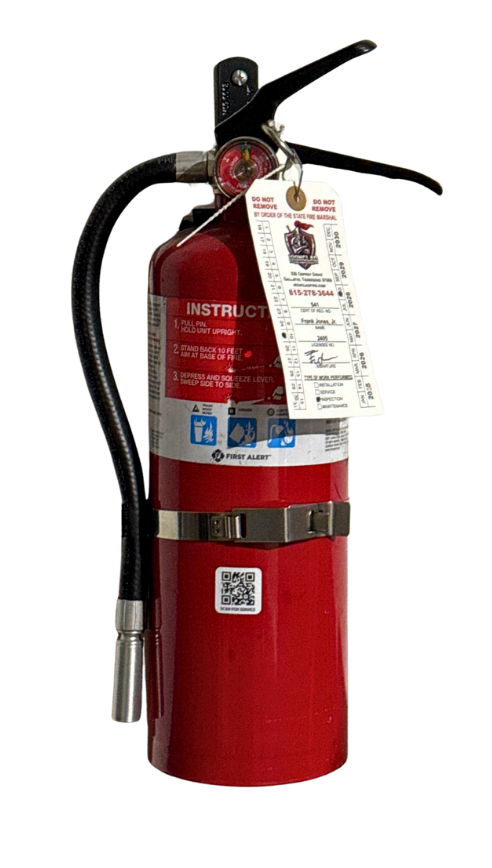
This is the red extinguisher you see in 90% of commercial buildings. It handles Class A, B, and C fires, which covers most hazards in a typical business.
What’s inside: Monoammonium phosphate powder that smothers the fire and interrupts the chemical reaction.
Why it’s everywhere: It’s the most versatile and affordable option. One extinguisher type covers the three most common fire hazards in office buildings, retail, warehouses, and most commercial spaces.
Common sizes:
- 5 lb — Small offices, inside individual rooms, supplemental coverage
- 10 lb — The standard. Most commercial buildings use these for hallway and common area coverage. This is what you’ll see in most buildings.
- 20 lb — Warehouses, large open areas, higher-hazard spaces where you need more agent
When to use which size: For most buildings, 10 lb is the standard. NFPA 10 has specific requirements based on hazard level and square footage, but 10 lb ABC extinguishers satisfy the requirements for the vast majority of commercial spaces.
Limitations:
- Messy. Dry chemical powder gets everywhere. After use, there’s significant cleanup. In a server room, the powder can damage electronics worse than a small fire would.
- Corrosive. The agent is mildly corrosive and can damage sensitive equipment if not cleaned up quickly.
- Not ideal for kitchens. ABC extinguishers can actually spread a cooking oil fire. That’s why restaurants need Class K.
Cost: $40-90 for a new unit depending on size. The most affordable extinguisher to buy, service, and maintain.
Class K (Wet Chemical) — Required for Every Commercial Kitchen
If your business has a commercial cooking operation — restaurant, cafeteria, catering kitchen, food truck — you need a Class K extinguisher. This is not optional.
What’s inside: Wet chemical agent (potassium acetate solution) that cools the oil and creates a foam blanket that prevents re-ignition.
Why ABC doesn’t work for cooking fires: Cooking oil fires burn at extremely high temperatures. An ABC extinguisher can scatter burning oil (spreading the fire) and doesn’t cool the oil enough to prevent re-ignition. Class K agents are specifically designed to cool and smother cooking oil fires.
Placement requirements:
- Within 30 feet travel distance of commercial cooking equipment
- Not behind the cooking line (you need to reach it without crossing through the hazard)
- In addition to — not instead of — ABC extinguishers in the kitchen area
Important: Class K is supplemental to your hood suppression system. Commercial kitchens are required to have an automatic hood suppression system over cooking equipment. The Class K extinguisher is a backup for fires that happen outside the hood’s coverage or after the suppression system has activated. It’s not a replacement for the hood system.
What the Fire Marshal looks for in restaurants: Current Class K extinguisher within 30 feet of cooking equipment, proper mounting, current inspection tag. This is one of the first things they check in a restaurant inspection.
Cost: $150-250 for a new unit. More expensive to purchase and service than ABC, but required by code.
For more on restaurant requirements, see our fire marshal inspection prep guide.
CO2 — Protecting Electronics Without the Mess
CO2 extinguishers discharge carbon dioxide gas that displaces oxygen around the fire. No residue, no powder, no cleanup.
What’s inside: Liquid CO2 under high pressure that converts to gas when discharged.
Best for:
- Server rooms and data centers
- IT closets and network rooms
- Electrical panels and switch rooms
- Any area with sensitive electronic equipment
Why CO2 over ABC: No residue. An ABC extinguisher in a server room means powder in every server, every switch, every cable — potentially causing more damage than the fire. CO2 leaves nothing behind.
Limitations:
- Class B and C only. CO2 doesn’t work on ordinary combustibles (paper, wood). If your server room also has a lot of paper or cardboard, you may need an ABC extinguisher nearby as well.
- No pressure gauge. CO2 extinguishers are checked by weight, not gauge. If it’s light, it’s been discharged or has a slow leak.
- Rapid oxygen displacement in small rooms. In a very small enclosed space, CO2 can reduce oxygen levels enough to be a hazard to the person using it. Proper ventilation matters.
- Heavier than ABC. A 10 lb CO2 extinguisher is noticeably heavier due to the high-pressure steel cylinder.
Cost: $100-200 for a new unit. Moderately more expensive than ABC.
Clean Agent — The Premium Option for Sensitive Equipment
Clean agent extinguishers (Halotron, FE-36, or similar) work like CO2 but are designed specifically for occupied areas with sensitive equipment.
What’s inside: A liquefied gas agent that evaporates cleanly after discharge.
Best for:
- Server rooms in occupied buildings
- Laboratories
- Museums and archives
- Medical equipment rooms
- Anywhere with sensitive equipment AND people present
Why clean agent over CO2:
- Safer for use in occupied spaces (less oxygen displacement risk)
- Won’t cause thermal shock to electronics (CO2 is extremely cold when discharged)
- Still leaves zero residue
Limitations:
- Expensive. Clean agent extinguishers cost 2-3x more than ABC and the agent itself is expensive to refill.
- Class B and C only. Same limitation as CO2.
- Smaller discharge volume. You get less agent per extinguisher, so they’re suited for smaller spaces.
Cost: $200-500+ for a new unit. Significantly more expensive to buy and service. Only makes sense where the equipment you’re protecting justifies the cost.
Water Extinguishers — Niche but Still Around
Water extinguishers are the simplest type — they spray water on the fire.
What’s inside: Pressurized water. That’s it.
Best for:
- Class A fires only — paper, wood, textiles, ordinary combustibles
- Warehouses with combustible storage
- Textile and manufacturing facilities
Where you still see them:
- Large storage facilities with primarily combustible materials
- Historic buildings where powder agents would damage finishes
- Specific industrial applications
Critical limitations:
- Never use on electrical fires (Class C). Water conducts electricity.
- Never use on grease or oil fires (Class B or K). Water makes grease fires explosive.
- Class A only. If there’s any electrical equipment or flammable liquids in the area, you need a different type.
Cost: $40-80 for a new unit. Inexpensive but very limited in application.
How to Figure Out What Your Building Needs
Walk Through by Area
The easiest way to determine what you need is to walk through your building room by room:
Offices and common areas: ABC dry chemical. Standard 10 lb units at 75-foot intervals in hallways. This covers 90% of commercial buildings.
Commercial kitchen: Class K within 30 feet of cooking equipment, PLUS ABC for the rest of the kitchen area.
Server room / IT closet: CO2 or clean agent. If people are frequently in the space, lean toward clean agent.
Warehouse / storage: ABC for most. Water extinguishers if you’re dealing with purely combustible materials and no electrical hazards.
Mechanical rooms: ABC typically. Check with your fire protection provider based on specific equipment.
Parking garage: ABC dry chemical.
Travel Distance Rules
NFPA 10 specifies maximum travel distances — the farthest anyone should have to walk to reach an extinguisher:
- Class A hazards: 75 feet maximum
- Class B hazards: 50 feet maximum
- Class K hazards: 30 feet maximum
Travel distance is measured by actual walking path, not straight-line distance. In a building with turns and obstacles, you need more extinguishers than the floor plan might suggest.
Mounting Height
- Units over 40 lbs: Top handle no higher than 3.5 feet from the floor
- Units 40 lbs or under: Top handle no higher than 5 feet from the floor
- All units: Bottom at least 4 inches from the floor
When in Doubt
Ask during your next inspection. A good fire protection technician will look at your building and tell you if you have the right types in the right places. If something’s wrong, we’ll tell you — and we’ll tell you what you actually need rather than trying to upsell you on expensive equipment you don’t require.
Frequently Asked Questions
Can I use one type of extinguisher for my entire building?
In most cases, ABC dry chemical covers the majority of a building. But if you have a commercial kitchen (Class K required) or sensitive electronics (CO2 or clean agent recommended), you’ll need multiple types.
Do I need a fire extinguisher in every room?
No. NFPA 10 requires coverage based on travel distance, not room-by-room. As long as anyone in the building can reach an extinguisher within 75 feet of walking distance (50 feet for Class B hazards), you’re compliant. Extinguishers are typically placed in hallways and common areas, not inside every individual room.
What’s the difference between CO2 and clean agent?
Both leave no residue and are safe for electronics. CO2 is cheaper but displaces oxygen (risky in small spaces) and is extremely cold when discharged (potential thermal shock). Clean agent is more expensive but safer in occupied spaces and won’t thermal-shock equipment.
How do I know if my extinguisher is the right type for the hazard?
Check the label on the extinguisher — it lists which fire classes it’s rated for (A, B, C, K). Then assess the hazards in the area where it’s mounted. If the hazards don’t match the rating, you need a different type or an additional extinguisher.
Can I move an extinguisher from one location to another?
You can, but verify the type matches the hazard at the new location and that travel distance requirements are still met at both the old and new locations. Don’t leave a gap in coverage by moving an extinguisher without replacing it.
My fire extinguisher says “BC” not “ABC” — is that okay?
A BC extinguisher handles flammable liquids and electrical fires but not ordinary combustibles (paper, wood, etc.). For most commercial spaces, ABC is required because you need Class A coverage. BC extinguishers are only appropriate for specific locations like certain industrial or mechanical areas.
The Bottom Line
For most businesses, the answer is simple: ABC dry chemical extinguishers throughout the building, plus Class K in the kitchen if you cook.
The exceptions — CO2, clean agent, water — are for specific situations. If you’re not sure whether you need them, you probably don’t. But if you have a server room, a commercial kitchen, or specialized equipment, it’s worth getting a professional assessment.
We check extinguisher types against your building’s hazards during every inspection. If something doesn’t match, we’ll flag it and recommend the right equipment. Get a quote for an inspection and we’ll make sure your building has the right coverage.