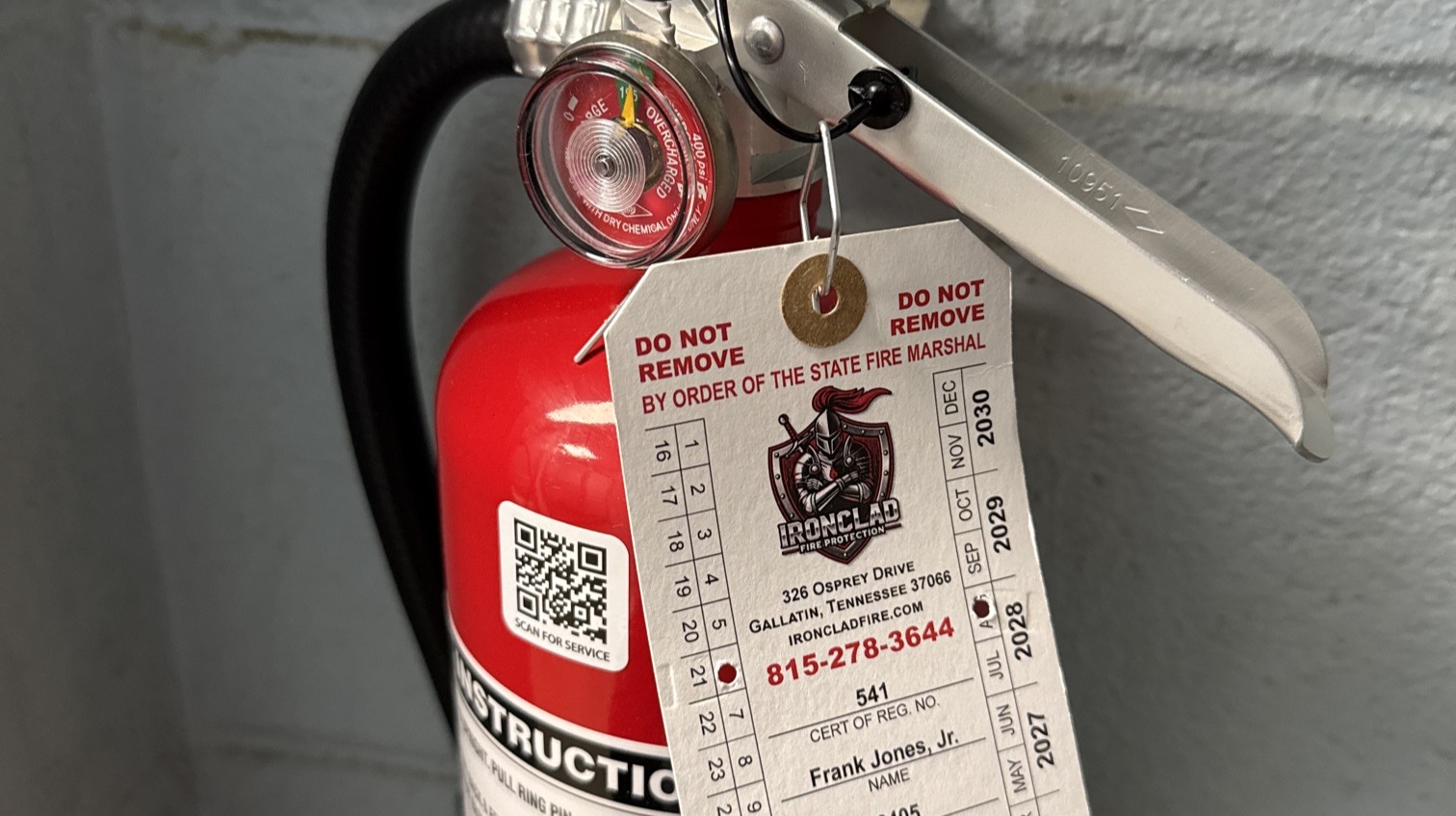
Fire Extinguisher Requirements for Tennessee Government Facilities
The short answer is: Tennessee government facilities follow the same NFPA 10 and NFPA 101 standards as commercial buildings — annual fire extinguisher inspections, monthly visual checks, 90-minute emergency light testing — but with higher documentation expectations, public safety obligations, and procurement requirements that make compliance more complex to manage.
Government buildings are held to the same fire codes as any commercial building. But in practice, they operate differently. Procurement has to go through purchasing departments. Documentation needs to survive audits. Multiple departments may share a building. And the public is in and out every day, which raises the stakes on life safety.
I work with county courthouses, city halls, public works facilities, and other government buildings in Middle Tennessee. Here’s what makes government facility compliance different from a standard commercial building.
What Tennessee Government Buildings Need
The fire protection requirements are the same NFPA standards that apply to all commercial buildings. But let’s lay them out specifically for government facility types:
Courthouses and City Halls
Fire extinguishers:
- ABC dry chemical in hallways, offices, and common areas
- 75-foot maximum travel distance
- Extinguishers in mechanical rooms, electrical rooms, server rooms, and storage areas
- Server/IT rooms may warrant CO2 or clean agent extinguishers
Emergency lights and exit signs:
- Battery-backed emergency lights in all corridors, stairwells, and public areas
- Illuminated exit signs at every exit and along egress paths
- Monthly 30-second functional tests
- Annual 90-minute battery drain tests
Special considerations:
- High public occupancy. Courthouses and city halls can have hundreds of people at any time — jury duty, public hearings, permit offices. Life safety systems need to work flawlessly.
- Multiple floors and wings. Older courthouses especially can have complex layouts where travel distance requirements are hard to meet without careful extinguisher placement.
- Secure areas. Courtrooms, evidence rooms, and restricted areas still need fire protection coverage, but access for monthly inspections may require coordination.
Public Schools and Libraries
Fire extinguishers:
- ABC dry chemical throughout corridors and common areas
- Class K in kitchen/cafeteria cooking areas
- Coverage in gymnasiums, auditoriums, shops, science labs
- Labs with flammable materials may need additional or specialized extinguishers
Emergency lights and exit signs:
- Full coverage of all corridors, stairwells, gymnasiums, auditoriums, and assembly areas
- Critical in assembly spaces where large numbers of students or public gather
- Annual 90-minute testing required
Special considerations:
- Assembly occupancy. Gymnasiums and auditoriums are assembly spaces with higher occupant loads and stricter egress requirements.
- Kitchen requirements. School cafeterias with commercial cooking need Class K extinguishers within 30 feet of cooking equipment — same as any restaurant.
- Summer closures. Buildings that sit unused for months can develop battery issues in emergency lights. Schedule testing before school resumes.
Public Works and Maintenance Facilities
Fire extinguishers:
- ABC in offices and common areas
- Larger units (20 lb) in vehicle bays and equipment storage
- Coverage near fuel storage, welding areas, and chemical storage
- Vehicle-mounted extinguishers on fleet vehicles (see our vehicle fleet guide)
Emergency lights and exit signs:
- Full coverage including vehicle bays, workshops, and storage areas
- Units in harsh environments (dust, heat, moisture) may need more frequent testing
Special considerations:
- Higher hazard areas. Vehicle bays with fuel, welding shops, chemical storage — these areas need appropriately sized and typed extinguishers beyond the standard 10 lb ABC.
- Harsh environment. Dust, fumes, and temperature swings degrade both extinguishers and emergency light batteries faster than climate-controlled office space.
Fire Stations
Yes, fire stations need fire extinguishers too.
Fire extinguishers:
- ABC in living quarters, offices, and common areas
- Coverage in vehicle bays (larger units)
- Extinguishers appropriate for any on-site training props or equipment
Emergency lights and exit signs:
- Full coverage — fire stations are occupied 24/7
Special consideration: Fire stations often get overlooked in municipal fire protection programs because “they’re the fire department.” But the State Fire Marshal’s requirements apply to all public buildings, including fire stations. The extinguishers in the apparatus bay still need annual inspection by a licensed firm.
Parks and Recreation Facilities
Fire extinguishers:
- ABC in community centers, recreational facilities, and offices
- Class K in any kitchen or concession stand with commercial cooking equipment
- Pool equipment rooms need Class C-rated extinguishers (electrical hazards)
Emergency lights and exit signs:
- Full coverage in enclosed public spaces
- Assembly areas (community centers, event spaces) have additional requirements based on occupant load
What Makes Government Compliance Different
Procurement and Budgeting
Government facilities don’t just call a fire protection company and say “come out tomorrow.” There’s usually:
- A purchasing process. Quotes, purchase orders, sometimes competitive bidding for contracts over certain dollar amounts.
- Budget cycles. Fire protection service needs to be budgeted annually. If it’s not in the budget, it doesn’t happen — and inspections expire.
- Approval chains. The facility manager knows the extinguishers are due, but the purchase order needs three signatures.
How to handle it: Get fire protection service into your annual budget as a standing line item. We provide annual contracts with predictable pricing so you can budget accurately year over year. No surprises, no emergency purchase orders.
Documentation and Audit Requirements
Government facilities face audit scrutiny that private businesses don’t. Fire protection documentation needs to be:
- Organized and accessible. An auditor or Fire Marshal should be able to review compliance records for any building in your portfolio without hunting through filing cabinets.
- Complete. Every extinguisher inspected, every emergency light tested, every service visit documented. Gaps in documentation are findings in audits.
- Retained long-term. Government records retention requirements may mean keeping fire protection documentation for 5-7+ years depending on the jurisdiction.
What we provide: Annual inspection reports, emergency light test documentation, service records for every unit. Everything organized by building and date, ready for audit or Fire Marshal review.
Multi-Building, Multi-Department Complexity
A county government might have:
- Courthouse
- County clerk’s office (separate building)
- Public works yard
- Sheriff’s office
- Library (or multiple branches)
- Parks and recreation facilities
- Health department
Each building has its own extinguishers, emergency lights, inspection dates, and potentially different departments responsible for maintenance. Without centralized management, buildings fall through the cracks.
How to handle it: Consolidate all buildings under one service provider with a master schedule. We track every building, every unit, and every due date — and send reminders before things expire. For more on managing multiple facilities, see our multi-property compliance guide.
Public Accountability
Private businesses face Fire Marshal inspections and insurance requirements. Government buildings face all of that plus public accountability. A news story about a county courthouse with expired fire extinguishers is a bad look for elected officials and department heads.
The practical impact: Government facilities should aim for zero compliance gaps. Not because the code is stricter (it’s the same code), but because the consequences of non-compliance are more visible.
Compliance Checklist for Government Facility Managers
Annual requirements:
- Fire extinguisher annual inspection by licensed TN firm (NFPA 10)
- Emergency light and exit sign 90-minute battery drain test (NFPA 101)
- Fire extinguisher 6-year maintenance (check unit ages)
- Fire extinguisher 12-year hydrostatic test or replacement (check unit ages)
- Documentation filed and organized by building
Monthly requirements:
- Fire extinguisher visual inspection (staff walkthrough)
- Emergency light 30-second functional test (press every button)
- Exit sign visual check (all lit, no burned-out letters)
- Document results and file
When anything changes:
- Building renovation → reassess extinguisher placement for travel distance
- New cooking equipment → verify Class K coverage
- New IT/server equipment → consider CO2 or clean agent
- Department moves or building use changes → review all fire protection coverage
Frequently Asked Questions
Do Tennessee government buildings follow different fire codes than private buildings?
No. Government buildings follow the same International Fire Code, NFPA 10 (fire extinguishers), and NFPA 101 (emergency lights) as commercial buildings. The requirements are identical. What differs is the procurement process, documentation expectations, and public accountability.
Can government maintenance staff perform annual fire extinguisher inspections?
No. Annual inspections must be performed by a technician working under a Tennessee-licensed fire extinguisher firm, regardless of whether the building is government or private. Government maintenance staff can and should perform monthly visual inspections.
How do we handle procurement requirements for fire protection service?
Most government purchasing departments accept annual service contracts with defined pricing. We provide contracts with per-unit pricing, scheduled service dates, and predictable annual costs that fit into standard budget processes. For larger contracts that require competitive bidding, we provide detailed proposals with line-item pricing.
What if different departments are responsible for different buildings?
Centralize fire protection service under one provider and one point of contact — typically the facility manager or general services department. Even if departments “own” their buildings, having one service provider with a master schedule prevents the gaps that happen when responsibility is fragmented.
Do historic government buildings have different requirements?
The building’s historic status doesn’t exempt it from fire code. Some accommodations may be made for the installation method (how extinguishers are mounted, for example), but the requirement to have working, inspected fire extinguishers and emergency lights applies to all occupied government buildings regardless of age.
How long should we retain fire protection service records?
Follow your jurisdiction’s records retention schedule. Most Tennessee government records retention policies require 5-7 years for maintenance records. When in doubt, keep everything — storage is cheap, and having records from 6 years ago beats explaining to an auditor why you don’t.
The Bottom Line
Tennessee government facilities follow the same NFPA standards as any commercial building. The difference is in the execution: procurement processes, audit-ready documentation, multi-building coordination, and public accountability.
The government facility managers who stay compliant without stress all do the same things: one service provider for all buildings, annual contracts budgeted as a standing line item, and centralized documentation that’s ready for any Fire Marshal or auditor.
If you manage government facilities in Middle Tennessee, get a quote for annual service. We work with counties, cities, and public agencies across the region — with the documentation and scheduling that government procurement requires.