Fire Extinguisher Requirements for Vehicle Fleets and Heavy Equipment
The short answer is: Commercial vehicles need at least a 5-B:C rated fire extinguisher, securely mounted and accessible to the driver. Hazmat vehicles need 10-B:C minimum. Heavy equipment needs 10-B:C or higher depending on the hazard. All of them need annual professional inspection just like the ones in your building.
Vehicle and equipment fires are more common than most fleet managers realize. Diesel fuel, hydraulic fluid, electrical systems, and hot exhaust components create fire risks that don’t exist in an office building. And when something catches fire on a truck or a piece of heavy equipment, you don’t have a fire department 3 minutes away — you have whatever’s in the cab.
FMCSA Requirements for Commercial Vehicles
If you operate commercial motor vehicles (CMVs), the Federal Motor Carrier Safety Administration requires fire extinguishers on board.
What’s Required
| Vehicle Type | Minimum Rating | Minimum Quantity |
|---|---|---|
| Standard commercial vehicle | 5-B:C | 1 |
| Vehicles hauling hazardous materials | 10-B:C | 1 |
| Cargo tanks (placarded hazmat) | 10-B:C | 1 (some require 2) |
Key FMCSA rules (49 CFR §393.95):
- Extinguisher must be securely mounted in the cab or on the vehicle — not rolling around in the back seat
- Must be readily accessible to the driver without having to move cargo or equipment
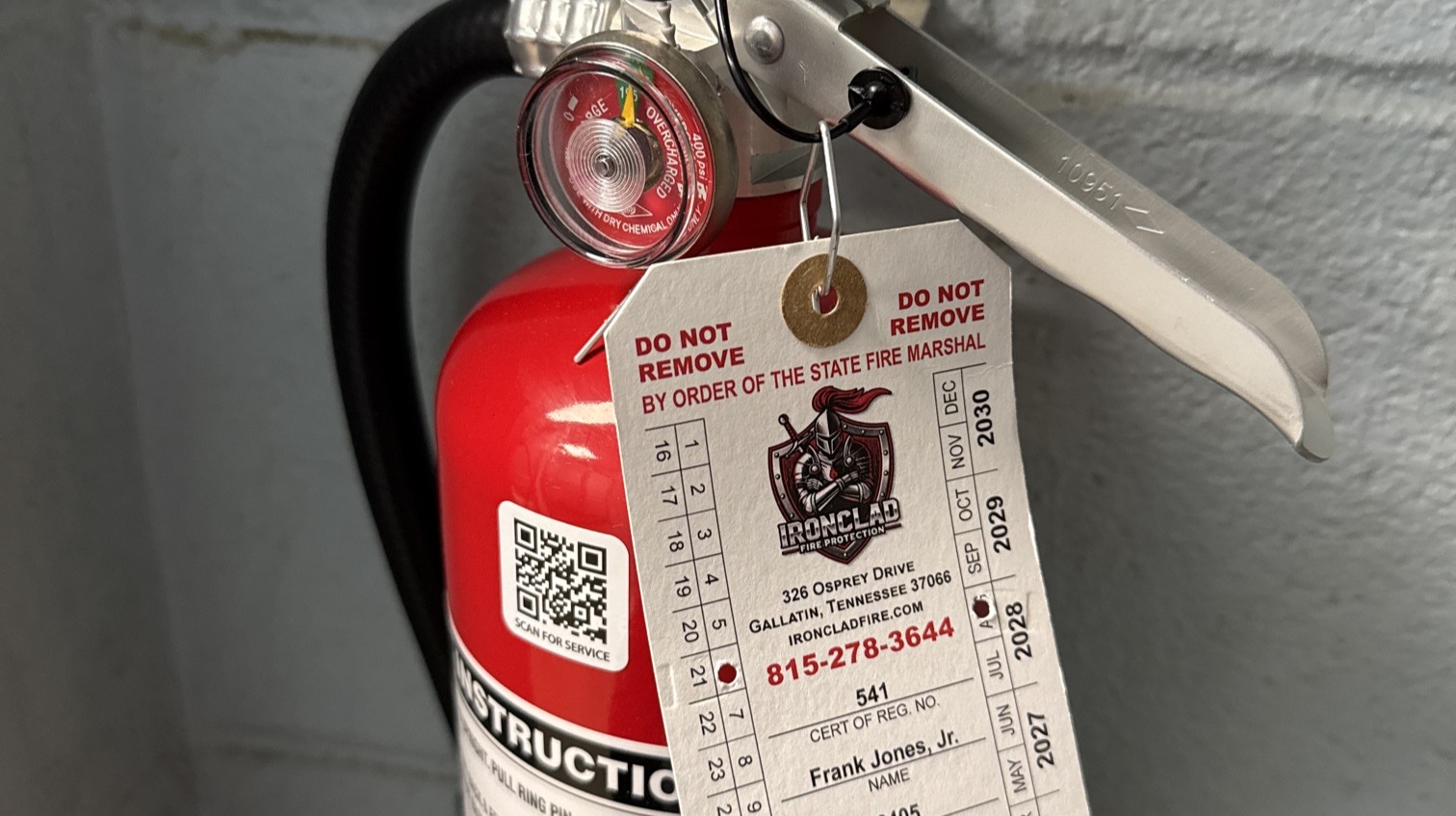
- Must have a current inspection tag — same annual inspection requirement as building extinguishers
- Must be properly charged — pressure gauge in the green zone
- Must be UL listed or approved — no cheap knockoffs
What Actually Makes Sense
The FMCSA minimum is 5-B:C. That’s a small extinguisher. For most commercial fleets, I’d recommend 10-B:C or a 2.5 lb ABC minimum. Here’s why:
- 5-B:C is bare minimum compliance. It handles a very small fire. A diesel fuel leak that ignites under the hood will overwhelm a 5-B:C extinguisher in seconds.
- 10-B:C gives you a fighting chance at a moderate fuel or electrical fire.
- ABC rated is better than just B:C — it also handles ordinary combustibles (paper, wood, upholstery) which you’ll find in cabs and cargo areas.
For most Tennessee fleets: A 2.5 lb or 5 lb ABC extinguisher (rated at least 10-B:C) mounted in the cab is the practical sweet spot. Small enough to not take up valuable space, large enough to actually be useful.
OSHA Requirements for Heavy Equipment
OSHA’s requirements for heavy equipment (29 CFR 1910.157 and 1926.150 for construction) are less specific than FMCSA but still enforceable.
The basics:
- Fire extinguishers must be provided where there’s a fire hazard — and heavy equipment running on diesel with hydraulic systems always qualifies
- Must be appropriate for the hazard — typically 10-B:C or higher for fuel and hydraulic fluid fires
- Must be accessible without leaving the operating position if possible
- Must be inspected and maintained per NFPA 10
Heavy Equipment-Specific Considerations
Hydraulic fluid fires are the big one. Hydraulic systems operate at extremely high pressure. A line rupture can spray fluid onto hot exhaust components and ignite instantly. These fires are intense and spread fast.
What heavy equipment operators need:
| Equipment Type | Recommended Rating | Why |
|---|---|---|
| Excavators, backhoes, loaders | 10-B:C minimum, 20-B:C preferred | Hydraulic systems, diesel fuel, hot components |
| Forklifts (propane) | 10-B:C minimum | Propane fuel, hydraulics |
| Forklifts (electric) | 10-B:C (ABC rated) | Battery fires, electrical systems |
| Cranes | 20-B:C | Large fuel tanks, extensive hydraulics |
| Generators and compressors | 10-B:C | Fuel, electrical |
| Welding rigs | 20-B:C (ABC rated) | Sparks, fuel, combustibles |
Mounting matters. On heavy equipment, vibration is constant. Extinguishers need heavy-duty brackets designed for vehicle mounting — not the wall brackets you’d use in a building. A standard wall bracket will shake loose in a week on a piece of construction equipment.
Inspection Requirements — Same as Buildings
Vehicle and equipment extinguishers follow the same NFPA 10 inspection schedule as building extinguishers:
- Monthly visual check — gauge in the green, pin intact, no damage, securely mounted
- Annual professional inspection — licensed technician, new tag, documentation
- 6-year internal maintenance — for stored-pressure dry chemical units
- 12-year hydrostatic test or replacement
The difference with fleet extinguishers: They take more abuse. Vibration, temperature extremes, dust, moisture — vehicle extinguishers degrade faster than building extinguishers sitting on a climate-controlled wall.
Practical recommendation: Check fleet extinguishers more often than monthly. A weekly visual check takes 10 seconds per vehicle. Gauges go bad, mounts shake loose, and drivers sometimes move or remove extinguishers.
For the full breakdown of inspection intervals, see our inspection frequency guide.
DOT Inspection and Compliance
Fire extinguishers are a standard inspection item during DOT roadside inspections and annual vehicle inspections.
What DOT inspectors check:
- Extinguisher present and properly mounted
- Current inspection tag (within 12 months)
- Gauge in operating range
- Pin and tamper seal intact
- Correct rating for the vehicle type
- Accessible to driver
What happens if you fail:
- Roadside inspection: Out-of-service violation. The vehicle doesn’t move until the extinguisher is corrected or replaced. That means a tow or a roadside service call.
- Annual inspection: Vehicle fails. Can’t be put back in service until corrected.
- FMCSA fines: Range from several hundred to several thousand dollars depending on the violation and circumstances.
The cost of a missing or expired extinguisher on a DOT inspection far exceeds the cost of just keeping them current. A tow bill alone can be $500-1,500 depending on the vehicle and location.
Fleet Management Tips
Standardize Your Equipment
Pick one extinguisher type and size for your entire fleet. This simplifies:
- Purchasing — bulk ordering the same unit
- Mounting — same bracket for every vehicle
- Inspection — technician knows exactly what to look for
- Replacement — keep spares on hand that fit any vehicle
Our recommendation for most Tennessee fleets: 2.5 lb ABC dry chemical, 1-A:10-B:C rated, with a vehicle-rated mounting bracket. Covers FMCSA requirements, handles the most common fire types, and fits in any cab.
Keep Spares
Stock extra extinguishers at your shop or yard. When an extinguisher is discharged, damaged, or fails inspection, you can swap it immediately rather than pulling a vehicle out of service while you wait for a replacement.
Track by Vehicle Number
Don’t just track “fleet extinguishers.” Track the extinguisher in Vehicle #103 separately from Vehicle #217. Each one has its own inspection date, maintenance schedule, and condition. A spreadsheet with vehicle number, extinguisher serial number, and last inspection date is all you need.
Annual Service with Your Building Extinguishers
If we’re already at your facility for annual building extinguisher inspection, we can inspect your fleet units at the same time. One trip, one invoice, everything documented.
Common Fleet Fire Extinguisher Problems
Extinguishers That “Disappeared”
Drivers remove them for more cab space. They fall off mounts and get left behind. Someone borrowed one for a job site. Fleet managers do a count and come up short.
Prevention: Check during every pre-trip inspection. Make it part of the daily checklist.
Expired Tags on Vehicles Nobody Thinks About
The office building extinguishers get inspected annually because someone sees them every day. The extinguisher in the utility truck that sits in the back lot? That one hasn’t been inspected in 3 years.
Prevention: Include every vehicle extinguisher in your annual inspection schedule. All of them. Even the ones on equipment that rarely moves.
Wrong Mounts
Building wall brackets on vehicle dashboards. Zip ties. Bungee cords. Sitting loose in the back seat. None of these are compliant, and none of them will keep the extinguisher in place during an accident — which is exactly when you might need it.
Prevention: Use DOT-rated vehicle mounting brackets. They’re designed for vibration and impact.
Extinguishers Covered in Dust and Grime
Construction equipment and utility vehicles get dirty. After 6 months, you can’t read the label or the gauge. The pin is caked with mud.
Prevention: Clean extinguishers during monthly checks. If you can’t read the gauge, you can’t verify it’s charged.
Frequently Asked Questions
Do pickup trucks used for business need fire extinguishers?
If it’s registered as a commercial motor vehicle (CMV) with a GVWR over 10,001 lbs or is used to transport hazardous materials, yes — FMCSA requires it. Light-duty pickups used for general business purposes don’t have a federal requirement, but it’s still smart practice. Some job sites and contracts require extinguishers on all vehicles regardless of size.
Can I use a residential fire extinguisher in my work truck?
You can, but you shouldn’t. Residential extinguishers are typically smaller, may not meet the minimum B:C rating, and aren’t built for the vibration and temperature extremes in a vehicle. Use a commercial-rated, UL-listed unit with a proper vehicle mount.
How often do fleet extinguishers need to be inspected?
Same as building extinguishers — annual professional inspection by a licensed technician per NFPA 10, plus monthly visual checks. Given the harsher environment, we recommend weekly visual checks for fleet units.
What if a driver uses the extinguisher?
Get it recharged or replaced immediately. A discharged extinguisher is useless and a DOT violation. If you keep spares, swap it out the same day and send the used one for recharging.
Do extinguishers need to be in the cab or can they be on the truck body?
FMCSA requires them to be readily accessible to the driver. Cab-mounted is ideal. If mounted on the truck body, it must be reachable without entering the cargo area or climbing. During a fire, seconds matter — the closer to the driver, the better.
The Bottom Line
Vehicle and equipment fire extinguishers follow the same NFPA 10 standards as building extinguishers — monthly checks, annual professional inspection, proper mounting, correct type for the hazard. The difference is that fleet extinguishers take more abuse and are easier to forget about.
Standardize your equipment, include fleet units in your annual inspection schedule, and check them more often than the minimum. A $40 extinguisher and a $15 annual inspection beats a $500 tow bill or a burned-up truck.
If you run a fleet in Middle Tennessee, we can inspect your vehicle extinguishers alongside your building units — get a quote and we’ll handle everything in one visit.