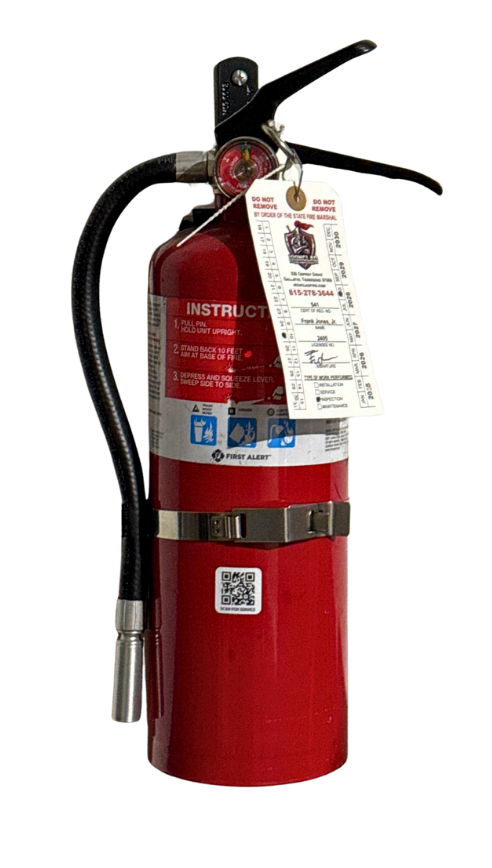
How to Read a Fire Extinguisher Label
The short answer is: A fire extinguisher label tells you three critical things: what types of fires it can handle (the letters — A, B, C, K), how much firefighting power it has (the numbers), and whether it’s been properly tested (UL listing). Here’s what every number and symbol on the label actually means.
Most people never look at their fire extinguisher label. They just see a red canister and assume it handles everything. It doesn’t. Understanding the label takes 2 minutes and could save your kitchen, your server room, or your life.
The Basics: Letters and Numbers
When you look at a fire extinguisher label, you’ll see something like this:
2-A:10-B:C
That’s not random. Every part means something specific.
The Letters — What Fires It Handles
Each letter represents a class of fire:
| Letter | Fire Type | Examples | Common Locations |
|---|---|---|---|
| A | Ordinary combustibles | Wood, paper, cloth, trash, plastics | Offices, warehouses, storage |
| B | Flammable liquids | Gasoline, oil, grease, solvents, paint | Garages, mechanical rooms, industrial |
| C | Electrical equipment | Anything plugged in or energized | Server rooms, offices, kitchens |
| D | Combustible metals | Magnesium, titanium, sodium | Specialty industrial/manufacturing |
| K | Cooking oils and fats | Deep fryer oil, cooking grease | Commercial kitchens |
Key point: A fire extinguisher only works on the fire classes listed on its label. Using the wrong class on a fire can make it worse — especially water on a grease fire (explosion) or ABC powder on a cooking oil fire (scatters burning oil).
The Numbers — How Much Power
The numbers before each letter tell you the extinguishing capacity:
The number before “A” represents water equivalency. Each unit = 1.25 gallons of water equivalent firefighting power.
- 1-A = equivalent to 1.25 gallons of water
- 2-A = equivalent to 2.5 gallons of water
- 4-A = equivalent to 5 gallons of water
The number before “B” represents the square footage of flammable liquid fire it can handle.
- 10-B = can extinguish a fire in 10 square feet of flammable liquid
- 20-B = 20 square feet
- 80-B = 80 square feet
Class C has no number. It just means the extinguishing agent won’t conduct electricity. If an extinguisher is rated C, it’s safe to use on energized electrical equipment.
Class K has no number either. The rating indicates it’s been tested and approved for commercial cooking fires using the specific wet chemical agent.
Reading Real Labels: Examples
Let’s decode some labels you’d actually see in the field:
“2-A:10-B:C” — Standard Office Extinguisher
- Handles Class A, B, and C fires
- 2.5 gallons water equivalent for combustible fires
- 10 square feet flammable liquid coverage
- Safe for electrical fires
- Where you’ll see it: Most offices, hallways, common areas
- Typical size: 5 lb ABC dry chemical
”4-A:80-B:C” — Heavy-Duty Commercial Extinguisher
- Same fire classes but much more power
- 5 gallons water equivalent
- 80 square feet flammable liquid coverage
- Safe for electrical fires
- Where you’ll see it: Warehouses, industrial buildings, large retail
- Typical size: 20 lb ABC dry chemical
”2-A:10-B:C, K” — Kitchen Dual-Rated
- Some newer units carry both ABC and K ratings
- However, most commercial kitchens use dedicated Class K units
- Where you’ll see it: Some light commercial kitchen applications
”10-B:C” — No Class A Rating
- Only handles flammable liquids and electrical fires
- Does NOT handle ordinary combustibles (paper, wood, etc.)
- Where you’ll see it: CO2 extinguishers in server rooms, electrical rooms
- Important: This extinguisher alone is not sufficient for most commercial spaces — you need Class A coverage too
The Pictograms — Visual Quick Reference
Modern fire extinguisher labels include pictograms — small icons that show at a glance what fires the extinguisher is designed for.
Green triangle with “A” = ordinary combustibles (trash can and wood pile icon)
Red square with “B” = flammable liquids (fuel can icon)
Blue circle with “C” = electrical equipment (plug and outlet icon)
Yellow star with “D” = combustible metals (gear/machinery icon)
Black hexagon with “K” = cooking media (pan with flames icon)
Red slash through a pictogram = DO NOT use on that fire type. This is critical. If you see a red slash, that means using this extinguisher on that fire class could make things worse or endanger you.
Example: A CO2 extinguisher will show green pictograms for B and C, but a red slash through A — because CO2 doesn’t effectively fight ordinary combustible fires.
The UL Listing Mark
Look for “UL Listed” or the UL mark on the label. This means Underwriters Laboratories has independently tested and certified the extinguisher.
Why it matters:
- A UL-listed extinguisher meets recognized safety and performance standards
- Fire Marshals expect UL-listed equipment
- Insurance companies may not accept non-UL-listed extinguishers
- Non-listed extinguishers may look identical but haven’t been performance-tested
If it’s not UL listed, don’t use it. This occasionally comes up with cheap extinguishers bought online or imported without proper certification.
The Inspection Tag vs. the Label
People confuse these. They’re two different things:
The label is permanently attached to the extinguisher body. It tells you the type, rating, instructions, and manufacturer information. It never changes.
The inspection tag is a paper or plastic tag hanging from the handle or neck. It shows when the extinguisher was last professionally inspected and by whom. This changes every year when your service company does the annual inspection.
| Information | Where to Find It |
|---|---|
| Fire class rating (A, B, C, K) | Body label (permanent) |
| Numerical rating (2-A:10-B:C) | Body label (permanent) |
| Manufacturer and model | Body label (permanent) |
| Manufacture date | Body label or stamped on cylinder |
| Last inspection date | Inspection tag (hanging tag) |
| Inspecting company and technician | Inspection tag (hanging tag) |
| 6-year maintenance record | Maintenance collar on cylinder neck |
| Operating instructions (PASS method) | Body label (permanent) |
Size and Weight Information
The label also shows the extinguisher’s weight, which corresponds to how much agent is inside:
| Weight | Typical Type | Best For |
|---|---|---|
| 2.5 lb | ABC dry chemical | Inside vehicles, very small spaces |
| 5 lb | ABC dry chemical | Small offices, individual rooms |
| 10 lb | ABC dry chemical | Standard commercial — hallways, common areas |
| 20 lb | ABC dry chemical | Large spaces, warehouses, industrial |
| 6 lb | Class K wet chemical | Standard commercial kitchen unit |
| 5 lb | CO2 | Small IT spaces |
| 10 lb | CO2 | Server rooms, electrical rooms |
| 15-20 lb | CO2 | Large data centers |
What size do you need? For most commercial buildings, 10 lb ABC is the standard. It satisfies NFPA 10 requirements for ordinary and moderate hazard areas. Use 5 lb for supplemental coverage in smaller rooms and 20 lb for high-hazard or large open areas.
The Manufacture Date
This is stamped on the cylinder body (not the label, usually on the bottom or neck of the cylinder). It tells you when the extinguisher was made.
Why it matters:
- 6-year maintenance is calculated from the manufacture date (for stored-pressure dry chemical)
- 12-year hydrostatic testing is calculated from manufacture date
- Extinguishers over 12 years old may need replacement rather than testing
How to find it: Look on the bottom of the cylinder or the neck ring. It’s typically stamped into the metal. Format varies — might be month/year, might be a date code.
For more on maintenance schedules, see our inspection frequency guide.
Operating Instructions
Every label includes basic operating instructions — typically the PASS method:
- Pull the pin (and break the tamper seal)
- Aim at the base of the fire (not the flames — the base)
- Squeeze the handle to discharge
- Sweep side to side across the base of the fire
Additional instructions on the label:
- Stand back 6-8 feet from the fire
- Keep your back to an exit
- If the fire doesn’t go out quickly, evacuate
- The label may specify additional precautions for the agent type (CO2 warnings about confined spaces, etc.)
What to Check on Your Labels Right Now
Walk your building and look at each extinguisher label. Check these three things:
1. Does the type match the hazard?
- Kitchen area → need “K” on the label
- Server room → should be CO2 (B:C) or clean agent, not ABC
- General hallways and offices → ABC (A, B, and C on the label)
- If the letters don’t match the hazards in the area, you need a different extinguisher
2. Is it UL Listed?
- Look for the UL mark. If it’s not there, replace the extinguisher.
3. Can you read it?
- Labels fade, get painted over, or peel off. If you can’t read the label, you can’t verify it’s the right type. That’s a violation and a safety issue. Time for a replacement.
Frequently Asked Questions
What does it mean when a fire extinguisher is rated “ABC”?
It means the extinguisher handles three classes of fire: A (ordinary combustibles like paper and wood), B (flammable liquids), and C (electrical equipment). This is the most common type in commercial buildings. The numbers before the letters (like 2-A:10-B:C) indicate the firefighting capacity for each class.
Why doesn’t Class C have a number rating?
The C rating simply means the extinguishing agent is non-conductive — safe to use on energized electrical equipment. There’s no capacity measurement because the C rating is about safety (won’t electrocute you), not about how much electrical fire it can fight. The actual firefighting power comes from the A and B ratings.
Can I use an ABC extinguisher on a kitchen grease fire?
You can, but you shouldn’t if commercial cooking equipment is involved. ABC dry chemical can scatter burning oil and doesn’t cool the oil enough to prevent re-ignition. Commercial kitchens require a Class K extinguisher within 30 feet of cooking equipment. For small residential-style kitchens (microwave, coffee maker), ABC is fine.
What’s the difference between the number rating and the size in pounds?
The size (lbs) tells you how much agent is inside the canister. The number rating tells you how much firefighting power that agent delivers. They’re related but not the same — a 10 lb ABC extinguisher might be rated 4-A:80-B:C while a 5 lb ABC might be 2-A:10-B:C. More agent generally means a higher rating, but the chemical formulation matters too.
My extinguisher label is faded or unreadable. Is that a violation?
Potentially, yes. The Fire Marshal needs to verify the extinguisher type matches the hazard. If they can’t read the label, they can’t verify compliance. More importantly, if a user can’t read the label in an emergency, they can’t confirm they’re using the right type. Replace extinguishers with unreadable labels.
Where can I find the manufacture date?
It’s stamped into the metal on the cylinder body — usually on the bottom or around the neck ring near the valve. It’s not on the paper label. Look for a month/year stamp or a date code. This date determines when 6-year maintenance and 12-year hydrostatic testing are due.
The Bottom Line
A fire extinguisher label tells you everything you need to know in a few characters: what fires it fights, how powerful it is, and whether it’s been properly tested. The critical check is matching the letters on the label to the hazards in the area where it’s mounted.
ABC covers most commercial spaces. Class K is required for commercial kitchens. CO2 or clean agent is best for electronics. If you’re not sure whether your extinguishers match your building’s hazards, we check this during every inspection and will tell you exactly what needs to change.
Get a quote for an inspection and we’ll verify every extinguisher in your building has the right type for the right location.