Tennessee Fire Marshal Violations: What to Fix First and How Long You Have
Handle anything that puts people at risk today, then work everything else off the date printed on the notice. That date is the only deadline that matters, and it is not the same for every finding.
If your citation is about extinguishers or emergency lights, you almost certainly have more time than the panic suggests. You also have a fix that ends in one visit.
Here is what the notice means, what to do first, and how to close each item so it does not come back next year.
How Long You Actually Have
The written notice controls this. Correction periods are set by the authority that issued it, and they move with the severity of what was found.
Ironclad’s Field Experience
For fire extinguishers and emergency lights, I usually see two to four weeks, and most often three to four.
Other systems get prioritized harder. How much harder depends on the severity of the deficiency, and I do not have specific timelines for those.
One thing I have noticed: almost every fire service except extinguishers and emergency lights gets tracked in a compliance platform. Whether that changes how fast an authority follows up, I honestly do not know.
Three to four weeks is comfortable, and that is exactly why people lose it. The notice goes in a drawer, the date arrives, and nothing has been scheduled.
Book the corrective work in the first week, not the third. A scheduled service confirmation is also the single most useful thing you can show if you end up needing more time.
Your First Hour With the Notice
Before you fix anything, capture the finding as written.
- Photograph or scan the notice itself, including the report number.
- For each finding, note the cited condition, the code section, and the exact location.
- Write down the due date next to each item. They may differ.
- Photograph each cited condition before you touch it.
- Note the contact listed on the notice and how they want evidence submitted.
That before photo matters more than people expect. Once the extinguisher is on the wall, you have no way to show what the marshal saw, and no way to show you fixed the thing they actually cited.
If any wording is unclear, call the contact on the notice and ask what result closes the finding. Keep that answer with the original.
Fix Immediate Hazards Before Anything Else
Some findings describe a condition that endangers people right now. A blocked or locked exit, an impaired alarm, a completely dark egress path.
Those do not wait for a scheduled visit. OSHA requires workplace exit routes to stay unobstructed and safeguards to remain in working order under 1910.37.
Clear the obstruction, unlock the door, call the alarm company. Then document the condition and the correction with dated photos, because immediate fixes are the ones people forget to prove.
The Three Findings That Bring People to Us
Three citations account for most of the calls we get, and all three are fast to close.
| What the notice says | What closes it |
|---|---|
| Expired or missing inspection tag | Professional inspection and a new tag, or replacement if the unit fails |
| Emergency lights failed the test | Battery replacement, fixture replacement, or an electrician if there is no voltage |
| Extinguisher not mounted or blocked | Proper mounting hardware at the right height, or clearing and reorganizing the access |
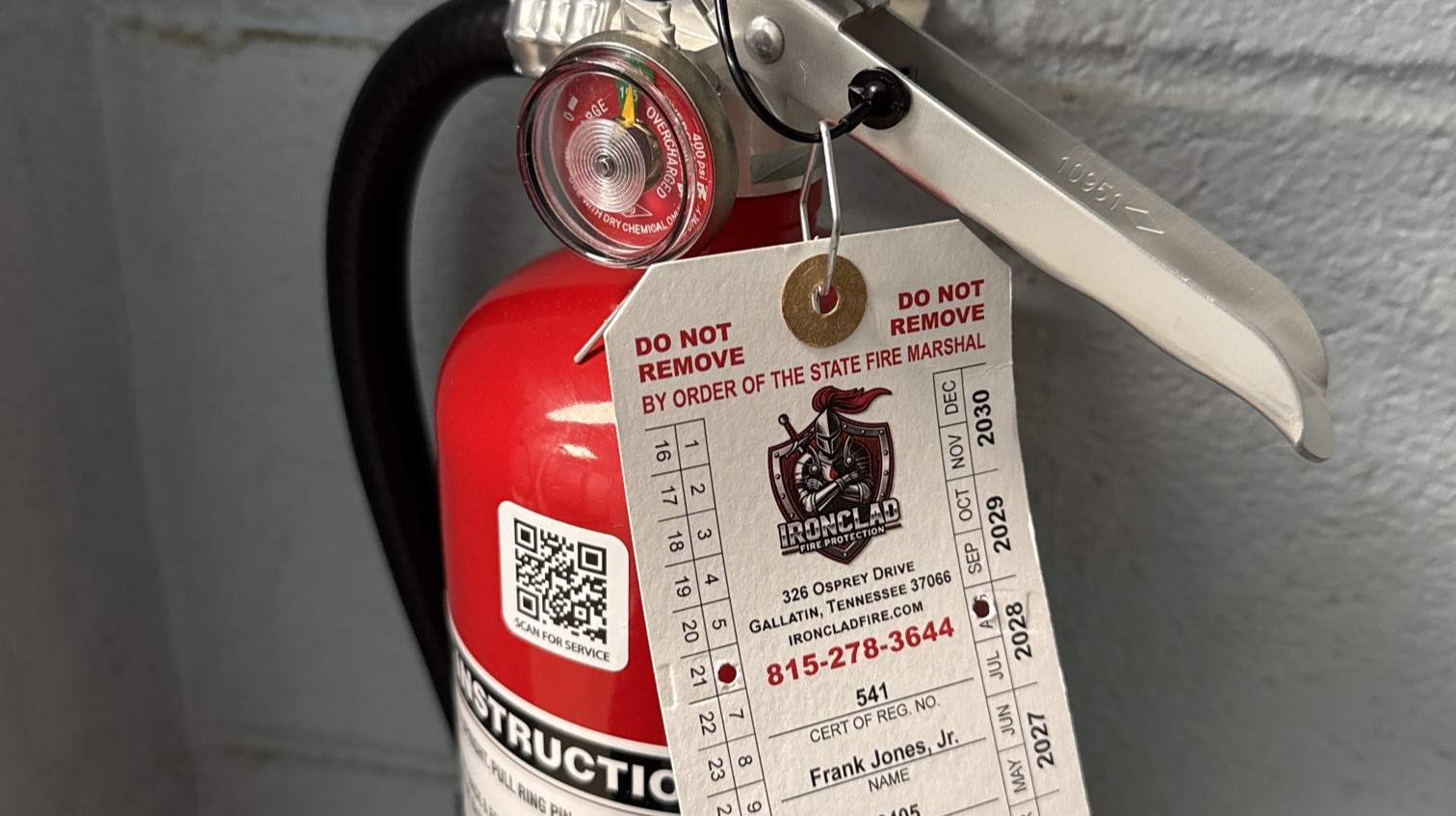
The expired tag is the most common citation there is. It takes an inspector three seconds to check and it is usually the first thing they look at.
Mounting is the one people try to fix cheaply and wrong. A nail is not a hook, and a unit on the floor is a finding no matter how current its tag is. Our guide to common extinguisher mistakes covers what correct mounting looks like.
For emergency light findings, a failed button test usually means a dead battery, but not always. Our emergency light testing guide walks the failure decision tree, including when the answer is an electrician rather than a battery.
What Gets Cleared in One Visit
Most extinguisher and light citations end the day the technician arrives. Some do not, and it is worth knowing which is which before you schedule.
Ironclad’s Field Experience
For extinguishers it is almost always one visit, unless a lot of units need replacing.
A specialty unit is the exception. If you need a Halotron, that is a return trip.
Emergency lights are similar. Once it is more than a few lights or batteries, it is probably a return trip.
The practical consequence is a scheduling one. If the notice cites a handful of items, one appointment closes it.
If it cites twenty fixtures or a specialty extinguisher, build a return trip into your timeline and get the first visit on the books early enough that the second one still lands before the date.
We schedule violation work next day or within a few days in most cases, which is usually the difference between comfortable and cutting it close.
Findings That Belong to Another Trade
A single notice often spans systems that no one contractor handles. Sending the wrong trade wastes days you may not have.
- Sprinkler systems. Painted or obstructed heads, clearance issues, overdue inspections. This is a sprinkler contractor.
- Fire alarm systems. Trouble conditions, damaged devices, overdue annual inspection. This is an alarm company.
- Electrical. Extension cords used as permanent wiring, daisy-chained power strips, overloaded circuits. This is an electrician.
- Permits and occupancy. High-piled storage, occupancy changes, hazardous materials. This goes back to the authority and often to a design professional.
Fixed suppression systems, including kitchen hood systems, are in our scope. Tennessee licenses them alongside portable extinguishers, so a hood finding does not need a separate contractor.
Route each finding on its own. One contractor guessing at another trade’s scope produces work that does not close the citation and a bill you still have to pay.
If You Are Going to Miss the Date
Say so before the date, not after. A request made in advance with evidence of progress reads completely differently than silence followed by a missed deadline.
Contact the authority using the method on the notice. A few sentences is enough, as long as they are specific.
Every bracket in that message matters. A specific date beats “as soon as possible,” a named reason beats “we are working on it,” and the closing question invites a written reply, which is the part you actually want.
Keep the written response. Asking for more time is not the same as receiving it, and a verbal “that should be fine” is not something you can produce later.
Ironclad’s Field Experience
I have not personally watched a closure happen. Escalating fines and shutdown orders are the tools a marshal has when they consider a deficiency serious.
That is not what a normal inspection looks like. Nobody walks in and starts threatening fines.
It comes up when something is badly overdue, like five to ten years expired, or when a building was already told to fix something and did not.
Even then they are threatened far more often than imposed. Most people comply, and the marshal comes back and does the re-inspection.
So the realistic cost of one missed deadline is more attention and another visit, not a penalty. Fines are what repeat non-compliance eventually earns, which is a different situation than the one you are in right now.
What Re-Inspection Looks Like
For serious findings the authority typically schedules the return visit. For minor ones you request it once corrections are complete.
Do not request it until everything is done. They are not making three trips, and a second failed visit puts you back at the start with less goodwill.
When the inspector returns they walk to each cited location, confirm the correction matches the requirement, and review your documentation. They can also find new issues, which happens.
Have three things ready at the door: the original notice, your evidence for each finding, and access to every cited area.
What Counts as Evidence
An invoice that says “service call” proves nothing. The evidence has to connect the work to the specific location that was cited.
Ironclad’s Field Experience
When the marshal does not physically come back for the re-inspection, here is what they usually want instead.
Extinguishers: updated tags, and often just photos of the tags.
Emergency lights: a test record. Mine is a PDF report, but a basic Google Sheet would work.
Fire suppression systems: new tags and a new report stating that everything was fixed.
Whatever form it takes, the record has to name locations. A report saying three units were serviced does not show that the cited three were among them.
Add dated before and after photos for anything physical, like a mounted unit or a cleared access path.
Store all of it with the original notice rather than in a vendor folder, so the whole file is one thing you can hand over.
Frequently Asked Questions
How long do I have to correct a violation?
Use the date on your notice. For extinguisher and emergency light findings we typically see two to four weeks, most often three to four, but severity and the issuing authority both change that.
Should I dispute a finding before correcting it?
Ask for clarification when the location or requirement is unclear, and keep controlling any immediate hazard while you do. Ignoring a finding you disagree with turns a correction issue into an enforcement issue.
Is a new inspection tag enough proof?
For a tag citation, usually yes, since the tag carries the service date. Keep the service report as well, because it is what covers findings that a tag does not show, like mounting.
Can my maintenance staff fix a mounting citation?
Yes, mounting is physical work and not licensed. It has to end up at the right height on hardware rated for the unit, and our extinguisher mistakes guide covers what inspectors look for.
What if the same finding comes back next year?
Then the routine is the problem, not the equipment. Our guide to preparing for a fire marshal inspection covers the walk and the schedule that keeps findings from recurring.
The Bottom Line
Read the notice, fix immediate hazards today, and schedule the rest in the first week. For extinguishers and emergency lights that gives you three weeks of margin on a job that usually takes one visit.
Route findings outside that scope to the right trade immediately, and keep a report that names every location you corrected.
If the date is going to slip, ask before it does. Marshals respond to evidence of progress, and they respond badly to silence.
Need a citation cleared? Get a quote for corrective extinguisher, emergency light, or fire suppression service in Middle Tennessee.