The Most Common Fire Extinguisher Mistakes
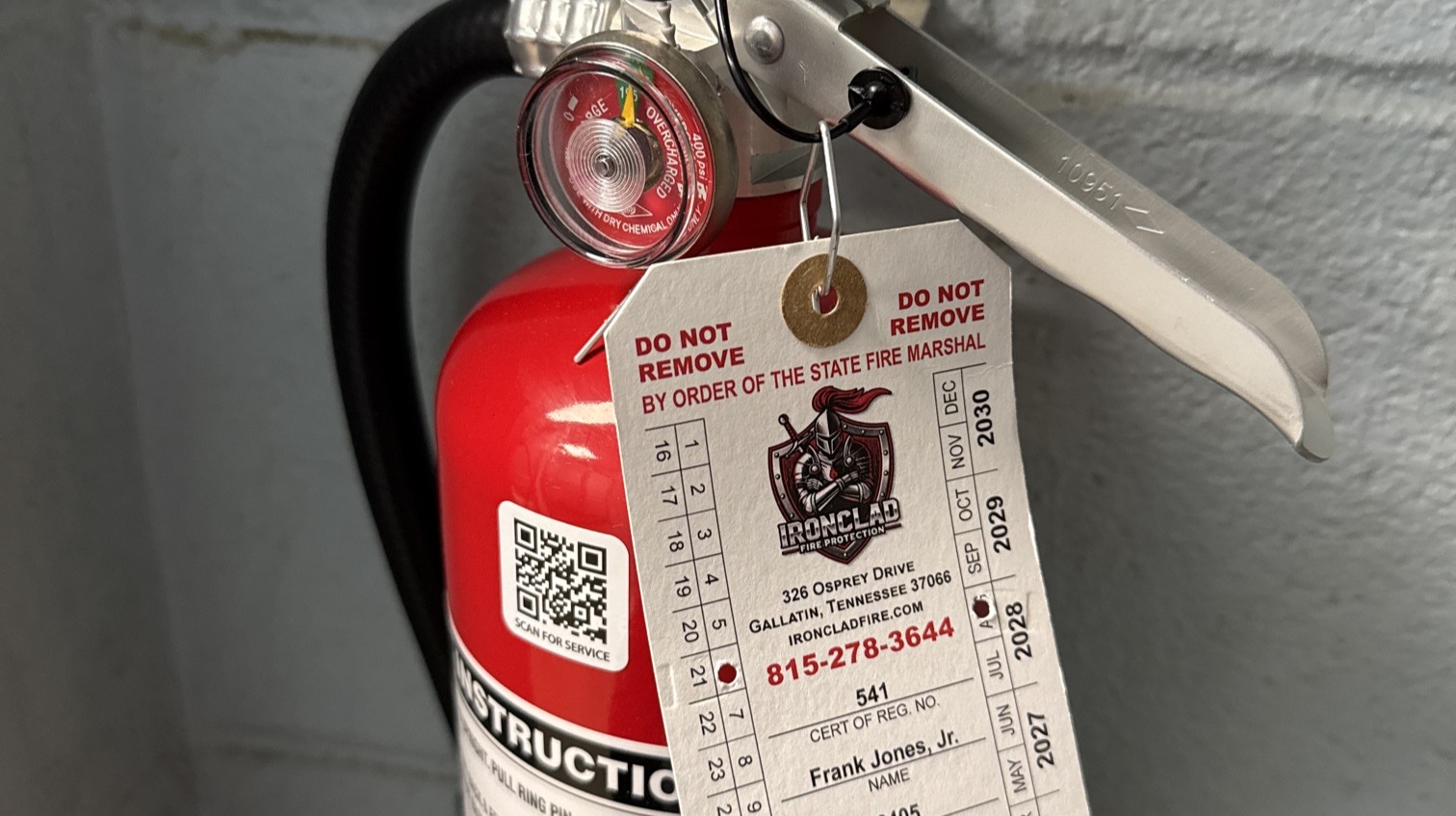
The short answer is: The most common fire extinguisher mistakes are expired inspection tags, blocked access, wrong extinguisher type for the hazard, and leaving damaged units in service. Here are the mistakes we see every week in Tennessee businesses — and what they actually cost you when the Fire Marshal shows up.
I inspect fire extinguishers in commercial buildings across Middle Tennessee. These are the mistakes I see over and over again — some obvious, some that surprise people.
1. Letting Inspection Tags Expire
This is the number one violation we see. It’s also the easiest to prevent.
What happens: Your annual inspection was 14 months ago. The tag says last year’s date. The Fire Marshal walks in, looks at the tag, and writes you up before checking anything else.
Why it happens:
- No reminder system in place
- You switched fire extinguisher companies and nobody picked up where the last one left off
- You assumed the building management company was handling it
- It just slipped through the cracks
What it costs you: A written violation with a 30-day correction deadline. If you don’t correct it, fines follow. Plus the emergency service call to get someone out there fast is more expensive than the scheduled annual visit would have been.
How to prevent it: Use a service company that sends automatic reminders. We contact our customers 30 days before their annual service is due. You don’t have to think about it.
2. Blocking Access to Extinguishers
This one’s everywhere. Boxes stacked in front of the wall mount. A filing cabinet pushed against it. Cleaning supplies leaning on it. A coatrack in front of it.
What happens: Someone needs the extinguisher in an emergency. They can’t reach it. Or the Fire Marshal walks by and sees a shelf of inventory blocking it.
The rule: 3 feet of clear space in front of every fire extinguisher. No exceptions.
Why it happens:
- People treat the area around extinguishers like free storage space
- Nobody told new employees where the extinguishers are or that they can’t be blocked
- Seasonal inventory gets stacked wherever there’s room
- Furniture gets rearranged and nobody checks
What it costs you: Violation citation. But honestly, the bigger cost is the liability if someone gets hurt because they couldn’t access the extinguisher. That’s a lawsuit.
How to prevent it:
- Put tape on the floor marking the 3-foot zone if you have to
- Include it in new employee orientation
- Check during your monthly visual walkthrough
- Make it someone’s specific job to keep access clear
3. Using the Wrong Extinguisher Type
This is the mistake that can actually make a fire worse.
The most common version: An ABC dry chemical extinguisher next to a commercial kitchen fryer. Someone has a grease fire, grabs the ABC, and the blast of powder scatters burning oil across the kitchen. A Class K wet chemical extinguisher would smother the oil and prevent re-ignition.
Other versions we see:
| Mistake | Why It’s Dangerous | Correct Type |
|---|---|---|
| ABC extinguisher on commercial cooking equipment | Scatters burning oil, doesn’t cool it | Class K (wet chemical) |
| Water extinguisher on electrical fire | Electrocution risk | ABC, CO2, or clean agent |
| ABC in a server room | Powder destroys every server in the room | CO2 or clean agent |
| No Class K in a restaurant kitchen | Cooking fires are the #1 restaurant risk | Class K within 30 feet of cooking equipment |
Why it happens:
- Building was set up with all ABC extinguishers and nobody reassessed when a kitchen was added
- Someone replaced an extinguisher with whatever was cheapest without checking the type
- Nobody explained the difference between extinguisher types
What it costs you: Fire Marshal citation for wrong type. But the real risk is making a fire worse. A grease fire that spreads because someone used the wrong extinguisher can total a kitchen in seconds.
How to prevent it: Have a fire protection professional assess your building by area. Different hazards need different extinguisher types. We check this during every inspection — if something doesn’t match, we flag it. For a detailed breakdown, see our fire extinguisher types guide.
4. Keeping Damaged or Discharged Extinguishers in Place
A dented cylinder with a cracked gauge. An extinguisher that was used 6 months ago and never recharged. Corrosion eating through the bottom of the tank. These are all ticking time bombs.
What happens: The extinguisher looks like it’s there doing its job. But when someone pulls the pin, nothing happens. Or worse — a corroded cylinder fails under pressure.
Signs an extinguisher needs to be pulled from service:
- Pressure gauge in the red (undercharged or overcharged)
- Visible dents or damage to the cylinder
- Corrosion anywhere on the body
- Tamper seal broken (may have been discharged)
- Hose or nozzle cracked, missing, or deteriorated
- Extinguisher feels lighter than it should (possible slow leak)
Why it happens:
- Monthly visual checks aren’t being done
- Someone used the extinguisher and didn’t report it
- Damage happened during normal building operations (forklift bump, drop, etc.) and nobody flagged it
- The extinguisher has been slowly corroding for years in a damp location
What it costs you: A damaged extinguisher is a violation. A discharged one that wasn’t recharged is a violation. But the real cost is having a non-functional extinguisher when you need one.
How to prevent it: Monthly visual inspections catch all of this. Five minutes walking your building, checking each extinguisher. If something looks wrong, call your service company. We carry replacement extinguishers on every truck and can swap out problem units same-day.
5. Extinguishers Sitting on the Floor
I see this constantly. Extinguishers sitting on the floor in a corner, leaning against a wall, propped up on a shelf. Not mounted.
What happens: Someone kicks it. It falls over. It rolls under a shelf. In an emergency, it’s not where anyone expects it to be.
The rule: Fire extinguishers must be wall-mounted using an appropriate bracket. Top of the handle no higher than 5 feet from the floor for units 40 lbs or under. Bottom at least 4 inches off the floor.
Why it happens:
- Someone removed it from the wall bracket and never put it back
- New extinguishers were delivered but never installed
- The wall bracket broke and nobody replaced it
- The building was renovated and extinguishers got displaced
What it costs you: Mounting violation. Plus a floor-sitting extinguisher is a trip hazard and more likely to get damaged.
How to prevent it: If you see an extinguisher on the floor, put it back on the bracket or get a new bracket installed. Every extinguisher should have a dedicated wall mount.
6. Missing or Unreadable Signage
If people can’t find the extinguisher in an emergency, it doesn’t matter how well-maintained it is.
What happens: Someone smells smoke and looks around frantically. The extinguisher is 10 feet away around a corner, but there’s no sign indicating its location. They waste 30 seconds looking.
The rule: Extinguisher locations must be marked — especially if the extinguisher isn’t immediately visible from the normal path of travel.
Why it happens:
- Signs were removed during painting and never put back
- Signs faded over time and nobody replaced them
- The building was never properly signed in the first place
- Signs are too small or poorly placed to be useful
How to prevent it: Photoluminescent signs (the kind that glow in the dark) are the best investment. They work in low light and power outages — exactly when you need them most. Mount them above each extinguisher.
7. Forgetting About 6-Year Maintenance
This is the mistake that catches even well-organized businesses off guard.
What happens: Your annual inspection tags are current. Monthly visual checks are being done. Everything looks compliant. But your stored-pressure dry chemical extinguishers are 8 years old and have never had their internal examination. You’re out of compliance and don’t even know it.
The rule: NFPA 10 requires internal maintenance every 6 years for stored-pressure dry chemical extinguishers. This is the standard ABC type in most buildings.
Why people miss it:
- They’ve never heard of 6-year maintenance
- Their previous service company never mentioned it
- They assume annual inspection covers everything
- There’s no obvious “expired” tag for 6-year maintenance like there is for annual inspection
What it costs you: Non-compliance, even though your annual tags are current. A thorough Fire Marshal or a fire incident investigation will check for this.
How to prevent it: Your fire extinguisher service company should track this for you. We monitor 6-year and 12-year milestones for all our customers and flag them during annual service. For more details, see our inspection frequency guide.
8. Not Knowing What the PASS Method Is
This isn’t a Fire Marshal violation, but it’s a safety failure.
PASS is the technique for actually using a fire extinguisher:
- Pull the pin
- Aim at the base of the fire (not the flames)
- Squeeze the handle
- Sweep side to side
Why it matters: In a real fire, adrenaline takes over. If nobody in your building has ever practiced using an extinguisher, they’re going to aim at the flames (wrong), stand too close (dangerous), or panic and not use it at all.
The fix: Run through PASS with your employees at least once a year. It takes 5 minutes. You don’t need to discharge an extinguisher to explain the technique.
9. Relying on Extinguishers That Are Too Small
A 5 lb extinguisher in a 5,000 sq ft warehouse. It’s technically there, but it’s not enough.
The rule: NFPA 10 specifies extinguisher size based on hazard level:
- Light hazard (offices): 2-A minimum rating
- Ordinary hazard (retail, warehouses): 2-A:10-B:C or higher
- Extra hazard (industrial): 4-A:40-B:C or higher
The practical version: Most commercial spaces use 10 lb ABC extinguishers as the standard. 5 lb units are fine for supplemental coverage in small rooms, but they shouldn’t be your primary protection in large spaces.
How to prevent it: A fire protection professional can assess whether your extinguishers are properly sized for each area. We check this during inspections.
10. Assuming Someone Else Is Handling It
The property management company thinks the tenant is maintaining the extinguishers. The tenant thinks the landlord is. Nobody is.
The reality: When the Fire Marshal inspects, they don’t care about your lease terms. Someone is getting a violation.
Why it happens:
- Lease doesn’t specify fire protection maintenance responsibility
- Multiple vendors create confusion about who’s handling what
- Building changed management companies and the new one didn’t inherit the fire protection schedule
How to prevent it: Specify fire extinguisher maintenance responsibility in the lease. Then verify — check the tags yourself, regardless of who’s supposed to be handling it.
Frequently Asked Questions
What’s the most common fire extinguisher violation in Tennessee?
Expired inspection tags. It’s not close. The Fire Marshal checks tags first during every inspection — it takes them 3 seconds to see whether you’re current. For more on handling violations, see our fire marshal violations guide.
How much do fire extinguisher violations cost?
Violation fines vary by jurisdiction, but the bigger costs are the emergency service call to get compliant quickly (premium pricing vs. scheduled service), potential re-inspection fees, and the liability exposure if a fire occurs while you’re non-compliant.
Can I fix fire extinguisher problems myself?
You can fix access and signage issues yourself (move the boxes, install a sign). But anything involving the extinguisher itself — recharging, replacing, repairing, annual inspection — must be done by a licensed fire extinguisher firm in Tennessee.
How often should I check for these issues?
Monthly. NFPA 10 requires monthly visual inspections by the building owner or staff. Walk your building once a month and check every extinguisher for the issues listed in this post. It takes 5 minutes.
What if I find a problem with an extinguisher?
If it’s an access or mounting issue, fix it immediately. If the extinguisher itself is damaged, discharged, or showing low pressure, take it out of service and call your fire protection company. We carry replacement units on every truck and can handle same-day swaps.
The Bottom Line
Every mistake on this list is preventable with two habits: monthly visual walkthroughs and annual professional service. The walkthroughs catch access, signage, damage, and mounting issues. The annual service catches everything else.
The businesses that get Fire Marshal violations aren’t the ones with bad luck — they’re the ones that don’t have a system. Set up monthly checks, use a service company with automatic reminders, and these mistakes stop happening.
If you’re not sure whether your building has any of these issues, get a quote for an inspection. We’ll walk your building, flag every problem, and fix what needs fixing — usually in a single visit.