Tennessee Fire Extinguisher Inspection Checklist
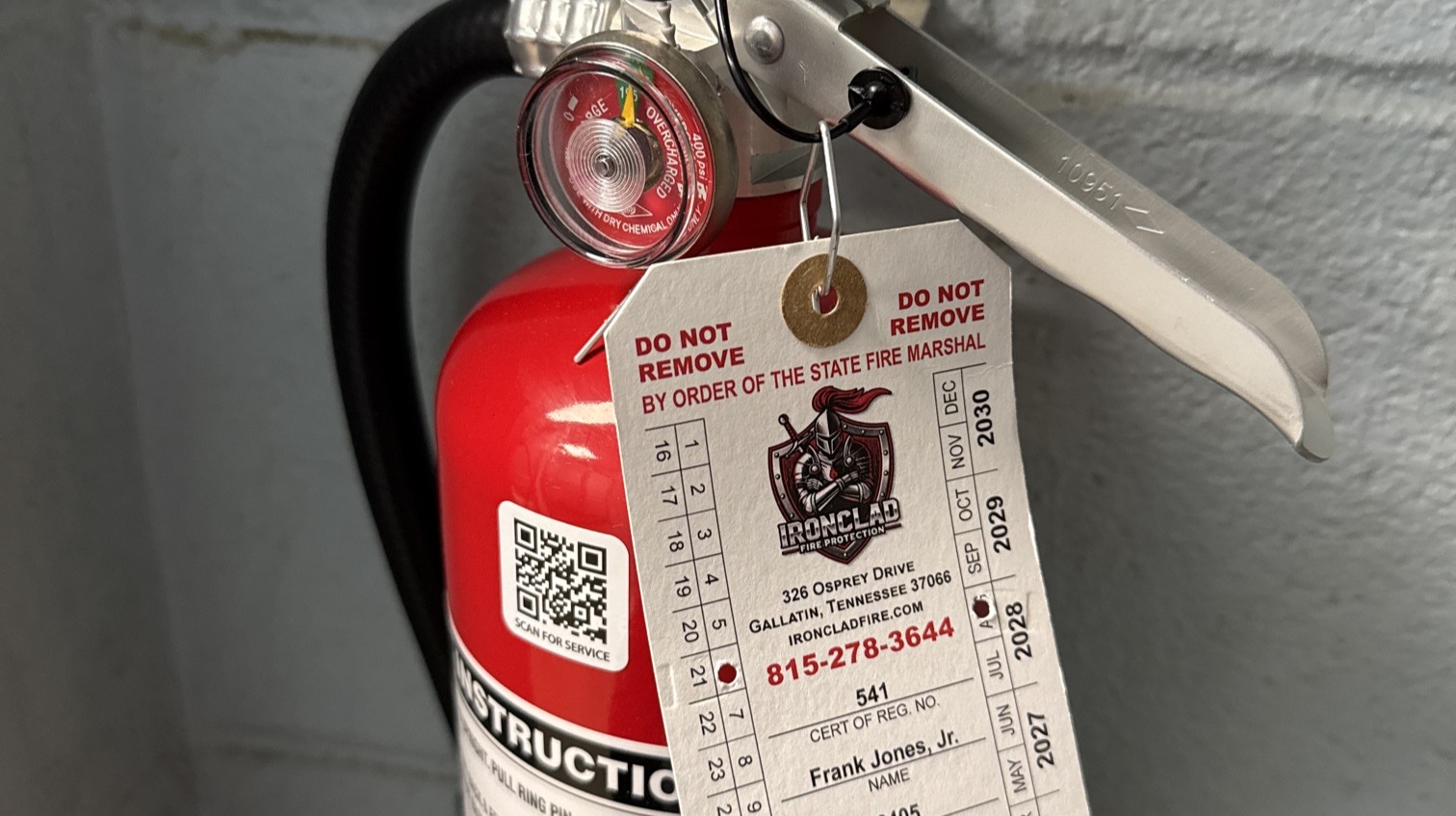
The short answer is: A fire extinguisher inspection checks for five things: current annual tag, proper pressure, no physical damage, correct placement, and clear access. Here’s the full checklist Tennessee businesses need to pass inspection.
If you’ve ever wondered “what exactly does a fire extinguisher inspection include?” — this is the breakdown. I’ll cover what you’re responsible for monthly, what we check during annual service, and the violations that actually fail people.
Monthly Visual Checks (Your Responsibility)
Tennessee fire code requires building owners or managers to do a quick visual check of every extinguisher every month. This isn’t complicated. You don’t need tools or training. Just walk the building and check these things:
Location and visibility:
- Extinguisher is in its designated location (not moved)
- Clearly visible — not hidden behind equipment, furniture, or boxes
- Wall sign above it is present and readable
Access:
- Nothing blocking access within 3 feet
- Not locked in a cabinet without a break-glass panel
- You can actually reach it quickly
Physical condition:
- Pressure gauge is in the green zone
- Safety pin is in place
- Tamper seal is intact (plastic ring around the pin)
- No visible damage, dents, or corrosion
- No leaking or discharge residue
- Hose and nozzle look intact
Mounting:
- Securely mounted to the wall (not sitting on the floor)
- Top handle no higher than 5 feet from the floor for units over 40 lbs
- Top handle no higher than 3.5 feet for smaller units
- Both per NFPA 10
How to document it: Most people initial the back of the inspection tag with the date. Some keep a log book. Either works. The point is you can show the Fire Marshal you’ve been doing monthly checks.
Annual Professional Inspection (What We Check)
Once a year, a licensed technician needs to inspect every extinguisher. This is the inspection that gets you the current tag — the thing the Fire Marshal looks at first.
Here’s what actually happens during an annual inspection:
Everything from the monthly check, plus:
- Full condition assessment of the hose, nozzle, and operating handle
- Weight verification for CO2 and clean agent extinguishers (these don’t have pressure gauges — weight is how you know they’re charged)
- Pull pin and tamper seal replacement if needed
- Detailed examination of the cylinder for corrosion, dents, or damage
- Verification that the extinguisher matches the hazard in that area
- New inspection tag with date, technician name, and company info
- Compliance documentation for your records
What you get: A current tag on every extinguisher and documentation ready for the Fire Marshal. That’s really what you’re paying for — proof of compliance.
For what this costs, see our pricing guide.
6-Year Maintenance (Internal Exam)
Most people don’t know about this one. Every 6 years, stored-pressure dry chemical extinguishers (the standard ABC type in most buildings) need an internal examination.
What happens:
- Extinguisher is completely discharged
- Cylinder is opened and inspected internally
- Valve stem, gaskets, and o-rings are replaced
- Cylinder is cleaned, refilled, and repressurized
- New 6-year maintenance tag applied
Why it matters: Internal corrosion, powder caking, and valve deterioration happen over time. The annual inspection can’t catch what’s inside the cylinder. Skip this and your extinguisher might not work when someone pulls the pin.
Which types need it: Stored-pressure dry chemical (ABC) extinguishers. That’s the majority of extinguishers in commercial buildings.
Which types don’t: CO2, clean agent, and cartridge-operated extinguishers have different maintenance schedules.
12-Year Hydrostatic Test
At the 12-year mark, the cylinder itself needs a pressure test to verify it can safely hold pressure.
What happens:
- Cylinder is pressurized with water to test structural integrity
- If it passes, it gets refilled and returned to service
- If it fails, the extinguisher is condemned
The reality: For standard ABC extinguishers, a 12-year hydro test often costs more than a new extinguisher. We usually recommend replacement at this point unless you have expensive specialized units (clean agent, large wheeled units, etc.).
Common Violations That Fail Inspection
After doing this for a while, I see the same violations over and over. Here’s what actually gets people in trouble:
Expired or Missing Tags
This is the number one violation. The Fire Marshal walks in, looks at the tag, and it expired 3 months ago. Instant citation.
How it happens: You forgot to schedule annual service, your vendor dropped the ball, or you switched companies and nobody picked up where the last one left off.
How to prevent it: Use a service company that sends automatic reminders. We contact our customers 30 days before service is due.
Blocked Access
Boxes stacked in front of the extinguisher. Filing cabinet pushed against the wall. Maintenance equipment leaning on it.
The rule: 3 feet of clearance in front of every extinguisher. No exceptions.
How to prevent it: Train your staff. Put tape on the floor if you have to. Make it someone’s job to check monthly.
Missing Extinguishers
Building was renovated and nobody added coverage to the new section. Extinguisher was removed and never replaced. One floor has coverage, the floor above doesn’t.
The rule: Maximum 75-foot travel distance to the nearest extinguisher in most commercial buildings.
How to prevent it: When anything changes about your building layout, reassess your extinguisher placement.
Wrong Extinguisher Type
Standard ABC extinguisher in a commercial kitchen (needs Class K). No CO2 or clean agent near server rooms. Water-based extinguisher near electrical panels.
How to prevent it: Have a fire protection professional assess your building. We do this during every inspection — if something’s wrong, we’ll tell you.
Damaged or Discharged Units Left in Place
Dented cylinder with a damaged gauge. Extinguisher that was clearly discharged but never recharged. Corrosion eating through the bottom.
How to prevent it: Monthly visual checks catch this. If something looks wrong, call your service company.
Missing Wall Signs or Mounting Brackets
Extinguisher is sitting on the floor in the corner. No sign above it. Nobody can find it in an emergency.
How to prevent it: Proper installation includes a wall bracket and signage. If yours are missing, get them installed.
The Full Checklist
Here’s everything in one place:
Monthly (you do this):
- Every extinguisher is in its designated spot
- Nothing blocking access (3-foot clearance)
- Pressure gauge in green zone
- Pin and tamper seal intact
- No visible damage or corrosion
- Mounted properly (not on the floor)
- Wall signs visible
Annual (licensed technician):
- Full condition assessment
- Weight verification (CO2 and clean agent)
- Hose, nozzle, and handle inspection
- Current tag applied
- Documentation generated
Every 6 years:
- Internal examination of stored-pressure dry chemical units
Every 12 years:
- Hydrostatic test or replacement
Frequently Asked Questions
Who can perform annual fire extinguisher inspections in Tennessee?
Annual inspections must be performed by a technician working for a licensed fire extinguisher firm. Tennessee requires firm certification through the State Fire Marshal’s office. Ironclad Fire Protection holds Firm Certification #541 and Specialist License #2405.
Can I do the monthly visual inspections myself?
Yes. Monthly visual inspections are intended to be performed by the building owner, manager, or designated staff. You don’t need certification for monthly checks — just follow the checklist above.
What happens if my extinguishers fail inspection?
If an extinguisher fails annual inspection due to damage, corrosion, or mechanical issues, it needs to be repaired or replaced. We carry replacement extinguishers on every truck and can swap out failed units during the same visit.
How do I know if my extinguishers need 6-year maintenance?
Check the tag. It should show the date of last 6-year maintenance. If there’s no 6-year tag and the manufacture date on the cylinder is more than 6 years ago, you’re overdue.
What’s the penalty for having expired fire extinguisher tags?
The Fire Marshal will issue a violation with a correction deadline — typically 30 days. If you don’t correct it, fines and re-inspection fees follow. For more on handling violations, see our fire marshal violations guide.
The Bottom Line
Fire extinguisher inspection in Tennessee comes down to staying on schedule and paying attention. Monthly visual checks take 5 minutes. Annual professional service handles the rest.
The businesses that fail inspection are the ones that forget about their extinguishers until the Fire Marshal shows up. Don’t be that business. Set up a system — monthly walks, annual service contract, automatic reminders — and inspections become routine.
If you’re not sure whether your extinguishers are current or compliant, get a quote and we’ll take care of it. We serve all of Middle Tennessee with same-day and next-day availability.