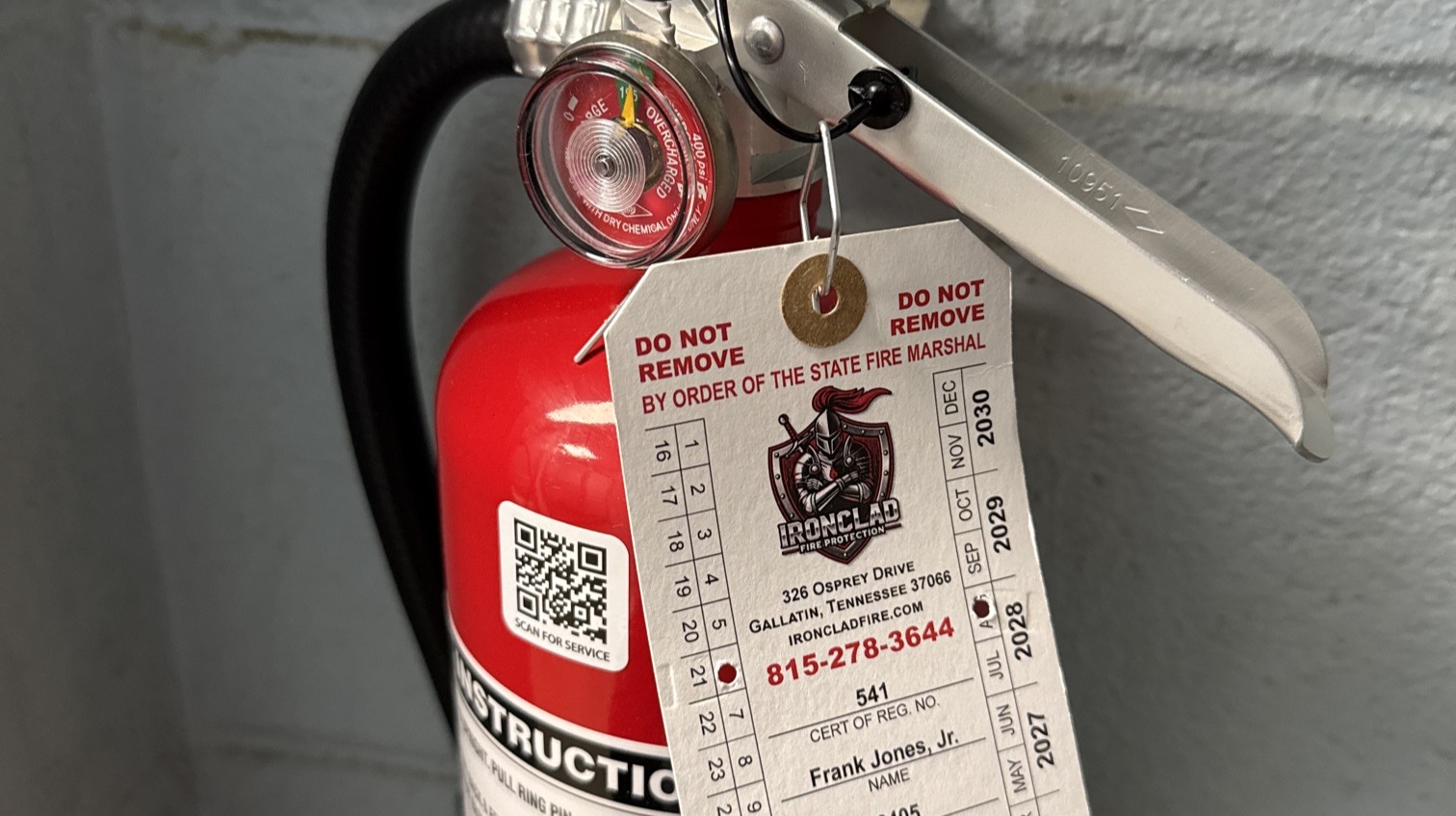
What Are the Fire Extinguisher Requirements for Tennessee Commercial Buildings?
The short answer is: Tennessee commercial buildings must have fire extinguishers inspected annually per NFPA 10, mounted in accessible locations within 75 feet of any point in the building, and maintained by a licensed fire extinguisher firm. Here’s what the code actually requires.
Tennessee fire code follows the International Fire Code (IFC) with state amendments. For fire extinguishers specifically, NFPA 10 (Standard for Portable Fire Extinguishers) is the governing standard. Your local Fire Marshal enforces these requirements at the building level.
Tennessee-Specific Licensing Requirements
Here’s something that sets Tennessee apart from some other states: Tennessee requires fire extinguisher companies to be licensed.
You can’t just have anyone inspect and tag your extinguishers. The work must be done by a technician employed by a firm that holds a Fire Extinguisher Firm Certification from the Tennessee State Fire Marshal’s office.
What this means for you:
- Verify your service company holds a valid Tennessee fire extinguisher firm certification
- Ask for their certification number
- The technician performing the work must be authorized under that firm’s license
Ironclad Fire Protection credentials:
- Fire Extinguisher Firm Certification #541
- Fire Extinguisher Specialist License #2405
- NFPA 10 and OSHA compliant
Why it matters: If your extinguishers are inspected by an unlicensed company, the inspection isn’t valid. The Fire Marshal can cite you for lack of proper service even if the tags look current.
Requirements by Building Type
Different building types have different fire protection needs based on occupancy classification and hazard levels.
Office and Commercial Buildings
What you need:
- ABC dry chemical extinguishers in hallways and common areas
- Maximum 75-foot travel distance to nearest extinguisher
- Extinguishers in mechanical rooms, electrical rooms, and storage areas
- Server rooms may need CO2 or clean agent extinguishers
Typical setup for a 10,000 sq ft office: 8-12 extinguishers depending on layout, mostly 10 lb ABC.
Retail Stores
What you need:
- ABC extinguishers throughout sales floor and stockroom areas
- 75-foot travel distance coverage
- Loading dock and receiving areas covered
- Storage room coverage (often missed)
Key concern: Merchandise displays and seasonal inventory can block access to extinguishers. Travel distance is measured by actual walking path around displays, not straight line.
Restaurants and Food Service
What you need:
- Class K wet chemical extinguisher within 30 feet of commercial cooking equipment
- ABC extinguishers throughout dining and non-cooking areas
- Kitchen hood suppression system (separate requirement, but related)
- Higher scrutiny from Fire Marshals — restaurants are high-risk occupancies
Key concern: The Class K requirement catches a lot of restaurant owners off guard. Standard ABC extinguishers are not safe for cooking oil fires. See our fire extinguisher types guide for details.
Industrial and Warehouse
What you need:
- ABC extinguishers at minimum, sized appropriately for the hazard
- Larger or additional extinguishers for higher-hazard areas
- 50-foot travel distance for Class B hazards (flammable liquids)
- Chemical storage areas may require specialized extinguishers
- High-piled combustible storage has additional requirements
Key concern: Warehouses have wide-open spaces that seem like they need fewer extinguishers, but travel distance rules still apply. A 200-foot aisle needs extinguishers at regular intervals.
Multi-Family Residential (Apartments)
What you need:
- Extinguishers in common areas — hallways, lobbies, laundry rooms, mechanical spaces
- 75-foot travel distance in common areas
- May or may not require unit extinguishers depending on local Fire Marshal interpretation
For the full breakdown, see our apartment building requirements guide.
Healthcare Facilities
What you need:
- Full coverage per NFPA 10 plus additional healthcare-specific requirements
- Patient care areas, corridors, utility rooms, kitchen areas all need coverage
- Staff must be trained on extinguisher use
- Higher documentation standards
Key concern: Healthcare facilities face the most stringent fire protection requirements. If you operate a healthcare facility, you likely need a fire protection consultant — not just an inspection company.
Placement Rules in Plain English
NFPA 10 has specific placement requirements. Here’s what they mean in practical terms:
Travel Distance
- Class A hazards (ordinary combustibles): Maximum 75 feet from any point to the nearest extinguisher
- Class B hazards (flammable liquids): Maximum 50 feet
- Class K hazards (cooking oils): Maximum 30 feet
“Travel distance” means walking distance — not straight-line distance. If someone has to walk around furniture, shelves, or walls, that counts.
Practical example: A 150-foot hallway needs at least 3 extinguishers (one at each end and one in the middle) to keep every point within 75 feet of an extinguisher.
Mounting Height
- Units over 40 lbs: Top of the operating handle no higher than 3.5 feet from the floor
- Units 40 lbs or under: Top of the operating handle no higher than 5 feet from the floor
- All units: Bottom of the extinguisher at least 4 inches from the floor
- Must be wall-mounted — not sitting on the floor, not leaning against a wall
Signage
- Extinguisher locations must be marked with a sign if the extinguisher isn’t immediately visible
- Signs should be mounted above the extinguisher
- Photoluminescent signs recommended (visible in low light)
- “FIRE EXTINGUISHER” text and/or pictogram
Accessibility
- 3-foot clearance in front of every extinguisher — nothing blocking access
- Must be on a normal path of travel (not in a locked closet without proper access)
- Not hidden behind furniture, equipment, or storage
- Not placed in areas that are inaccessible during an emergency
Inspection and Maintenance Schedule
Tennessee follows NFPA 10 requirements for inspection intervals:
| Requirement | Frequency | Who Does It | Documentation |
|---|---|---|---|
| Monthly visual inspection | Every month | Building owner/staff | Log or tag initials |
| Annual professional inspection | Every 12 months | Licensed TN firm | Inspection tag + report |
| 6-year internal maintenance | Every 6 years | Licensed TN firm | Maintenance collar + report |
| 12-year hydrostatic test | Every 12 years | Licensed TN firm | Test tag or replacement |
For a detailed breakdown of each inspection type, see our inspection frequency guide.
The one most people miss: 6-year maintenance. Your annual tags can be perfectly current and you’re still out of compliance if stored-pressure extinguishers haven’t had their 6-year internal exam.
What the Fire Marshal Actually Checks
When the Fire Marshal walks into your building, here’s what they’re looking at — roughly in this order:
1. Tags first. Are the annual inspection tags current? This takes 3 seconds per extinguisher. Expired tags are the most common violation.
2. Correct types. Is the right extinguisher type for the hazard in the area? ABC in the hallway, Class K near the kitchen, etc.
3. Proper mounting and placement. Wall-mounted at correct height? Not sitting on the floor? Travel distance covered?
4. Signage. Can you find the extinguishers quickly? Are locations marked?
5. Access. Nothing blocking the extinguisher? 3-foot clearance?
6. Physical condition. Gauges in the green? No visible damage or corrosion? Pin and seal intact?
7. Documentation. Can you produce service records? Monthly inspection logs? A Fire Marshal who asks for documentation and gets a blank stare is going to look harder at everything else.
For more on this, see our fire marshal inspection prep guide.
Penalties for Non-Compliance
Violation Notices
The Fire Marshal issues a written violation with specific code references and a correction deadline. Typical timelines:
- Life safety issues (missing extinguishers in critical areas): Days, not weeks
- Expired inspections, wrong types: Usually 30 days
- Minor issues (signage, minor mounting corrections): 30-60 days
Re-Inspection
Once you correct violations, the Fire Marshal comes back to verify. Some jurisdictions charge re-inspection fees ($50-200 depending on the area).
Escalation
If you don’t correct violations:
- Additional inspection with shorter deadline
- Formal enforcement notice
- Fines (vary by jurisdiction and severity)
- Orders to cease operations until compliant
- Legal action
How to avoid all of this: Stay current on annual inspections and fix problems when your service company identifies them. The businesses that get hit with enforcement are the ones that ignore violations for months.
For more on handling violations, see our fire marshal violations guide.
Common Compliance Mistakes
Switching vendors and losing continuity
You switch fire extinguisher companies and the new company doesn’t know your 6-year maintenance history. They do annual inspections — everything looks fine. But your extinguishers are actually overdue for internal maintenance.
Prevention: Keep your own records. When switching companies, share maintenance history with the new vendor.
Renovations that change the layout
You remodel and the hallway is now longer. Or a wall gets added that changes the travel distance. The old extinguisher placement no longer meets the 75-foot rule.
Prevention: Any time your building layout changes, reassess extinguisher placement.
Assuming the landlord handles it (or the tenant)
In leased spaces, fire extinguisher responsibility depends on the lease. If it’s not specified, neither party does it. The Fire Marshal doesn’t care about your lease — they’ll cite whoever is operating the building.
Prevention: Specify fire protection maintenance responsibility in the lease. Then verify it’s actually happening.
Thinking “we’ve never been inspected” means you’re exempt
Some buildings go years without a Fire Marshal visit. That doesn’t mean the requirements don’t apply. When the inspection eventually comes — or when a fire happens — non-compliance has the same consequences whether you’ve been inspected before or not.
Frequently Asked Questions
Does Tennessee require fire extinguishers in all commercial buildings?
Yes. The International Fire Code adopted by Tennessee requires portable fire extinguishers in commercial buildings based on occupancy type and hazard classification. The specific quantity and type depends on your building, but some level of coverage is required for virtually all commercial occupancies.
How do I find out my specific requirements?
Contact your local Fire Marshal’s office. They can tell you exactly what your building’s occupancy classification requires. You can also have a licensed fire protection company assess your building — we do this during every inspection.
Is there a Tennessee state database of licensed fire extinguisher firms?
Yes. The Tennessee Department of Commerce & Insurance, State Fire Marshal’s office maintains records of licensed fire extinguisher firms. You can verify any company’s license status through their office.
What if my building was built before current codes were adopted?
Existing buildings are generally required to comply with the fire code in effect when they were built OR the current code, depending on the jurisdiction and the specific requirement. Some requirements (like having working fire extinguishers with current inspections) apply to all buildings regardless of when they were built. Check with your local Fire Marshal for specifics.
Do I need different extinguishers on different floors?
Not necessarily different types — unless different floors have different hazards (like a restaurant on the first floor and offices above). Every floor needs coverage meeting the travel distance requirements, with the correct type for the hazards present on that floor.
Can my employees do the annual inspection?
No. Annual inspections must be performed by a technician employed by a Tennessee-licensed fire extinguisher firm. Your employees can and should do monthly visual inspections, but the annual service requires a licensed professional.
The Bottom Line
Tennessee fire extinguisher requirements for commercial buildings come down to a few fundamentals:
- Have the right types for the hazards in your building
- Place them correctly — 75 feet maximum travel distance for most areas
- Keep them current — annual inspections by a Tennessee-licensed firm
- Don’t forget the milestones — 6-year maintenance and 12-year testing
- Document everything — tags, service reports, monthly inspection logs
- Use a licensed company — unlicensed inspections don’t count in Tennessee
The code isn’t complicated. The hard part is staying on top of it year after year. That’s where a reliable service company with automatic reminders makes the difference.
If you need to get your building compliant or aren’t sure where you stand, get a quote. We offer same-day service across Middle Tennessee and can assess your building’s requirements during the inspection.